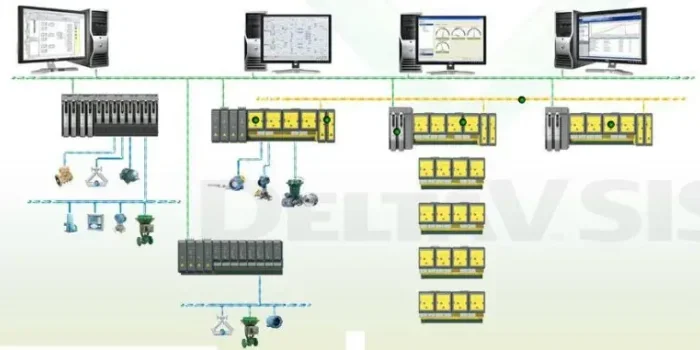
emerson-deltav-esd-sis-training
Emerson DeltaV ESD/SIS Training
Training Duration: 10 Days
Safety Instrumented Systems (SIS) are essential in providing a protective layer of functionality in many industrial process and automation systems. These systems are often referred to as Emergency Shutdown Systems (ESD) or Process Shutdown Systems (PSD).
Today, SIS plays an increasingly critical role in process plants. With safety standards such as IEC 61508, IEC 61511, and ISA S84.01 becoming more stringent, the requirements for safety in industrial processes have heightened, pushing organizations to adopt more advanced safety measures.
Depending on the application, other terms used for Safety Instrumented Systems (SIS) include:
-
Emergency Shutdown Systems (ESD)
-
Burner Management Systems (BMS)
-
Fire and Gas Systems (F&G)
-
High Integrity Protection Systems (HIPS)
-
High Integrity Pressure Protection Systems (HIPPS)
Safety methods employed in SIS are designed to protect personnel, plants, and the environment from harm or damage while reducing operational risk. These methods aim to mitigate hazards by ensuring that safety-critical systems perform reliably when needed.
-
Changing the process or engineering design
-
Increasing mechanical integrity of the system
-
Improving the Basic Process Control System (BPCS)
-
Developing detailed training and operational procedures
-
Increasing the frequency of testing of critical system components
-
Using a safety Instrumented System (SIS)
-
Installing mitigating equipment
Syllabus
-
DeltaV SIS Introduction
-
DeltaV SIS Overview
-
DeltaV SIS Architecture Overview
-
DeltaV SIS with Marshaling Hardware
-
DeltaV SIS Safety Instrument Functions
-
DeltaV SIS Communications
-
DeltaV SIS Explorer
-
DeltaV SIS Graphics Development
-
DeltaV SIS Programming Methods
-
DeltaV SIS Version Controls
-
DeltaV SIS Cause & Effect Matrix
-
DeltaV SIS Analog Voters
-
DeltaV SIS Digital Voters
-
DeltaV SIS Hardware Design
-
DeltaV SIS Network design
-
DeltaV SIS Diagnostics
-
DeltaV SIS Commissioning
-
DeltaV SIS safety instruments
-
Real time practice with ESD valve’s and ESD transmitters
-
Project based learning